


Between 2024 and 2025, Zvezdara Digital, a 140-person Belgrade-based analytics consultancy, undertook a systematic operational transformation designed to reduce coordination costs, standardize internal processes, and improve delivery performance. Over eighteen months, the company restructured its meeting culture, communication practices, and onboarding procedures. The case examines the implementation and outcomes of that effort.
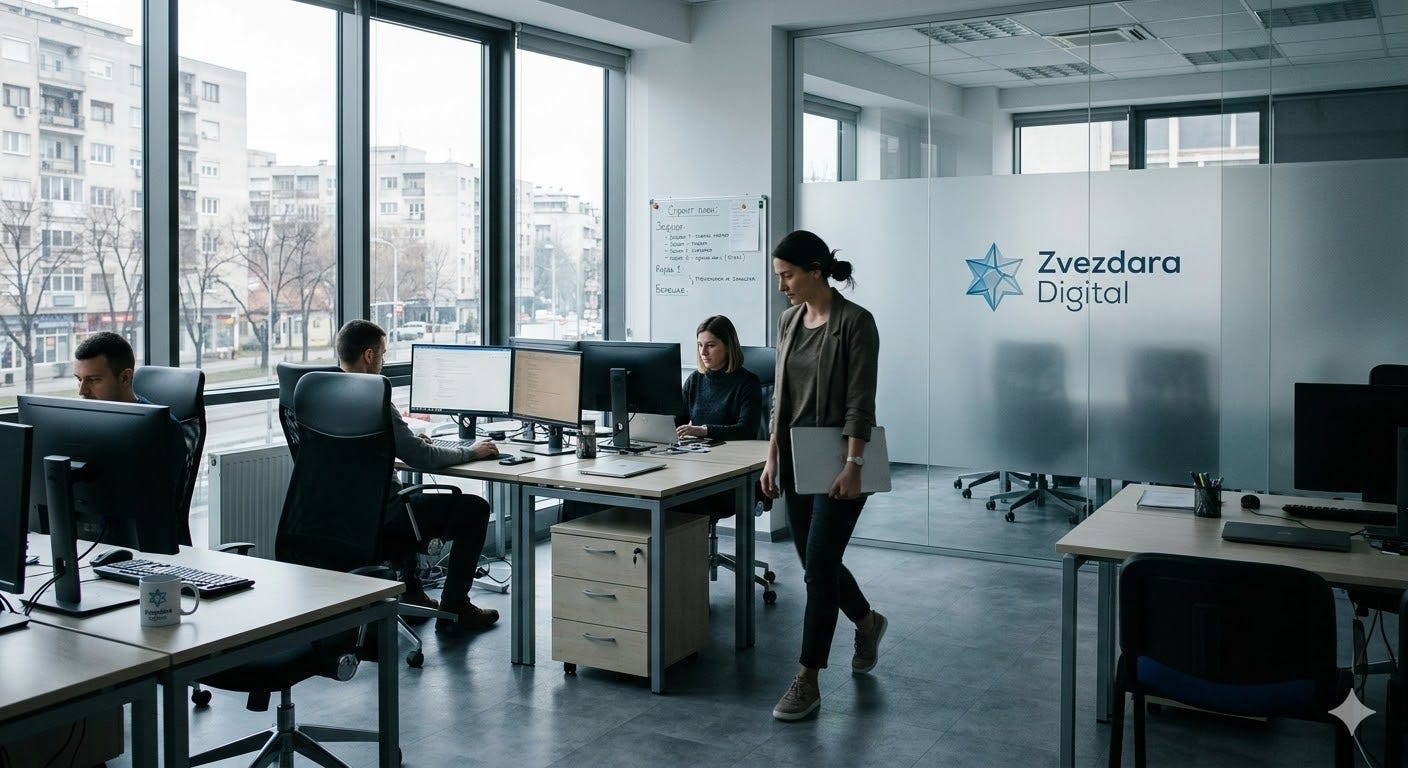
In early 2024, Zvezdara Digital was performing well by most external measures. The company, founded in 2016 by Dragan Pavlović, had grown to 140 employees and established itself as one of Belgrade’s stronger independent analytics consultancies, known for its data engineering capabilities and a reputation among regional clients for high-touch, relationship-driven service. Revenue had grown at a compound annual rate of roughly 18% since 2019, and the company had maintained client retention rates above 90% for three consecutive years.
Pavlović, however, was not satisfied. Margins had compressed slightly in 2023 despite rising revenues, and several senior hires brought in from larger firms had remarked on the absence of standardized processes. The company had grown organically, and its operating culture reflected that history. “We were a relationship-driven company,” Pavlović told us in January 2026. “That’s a polite way of saying nothing was systematized. The quality of any given project depended almost entirely on who was staffed to it.”
In March 2024, Pavlović recruited Milena Vasić as Chief Operating Officer. Vasić had spent eight years at Deloitte’s Belgrade office and three years leading operations for a mid-size fintech in Novi Sad. Her mandate, as Pavlović described it, was to “build a company that could scale without depending on any single person’s knowledge or goodwill.”
Vasić’s first initiative was a company-wide time audit conducted over six weeks, in which all billable employees logged their activities in fifteen-minute increments. The results confirmed what Pavlović had suspected: approximately 40% of billable employees’ time was allocated to activities with no direct connection to project deliverables. These included recurring meetings without documented agendas, informal consultations between colleagues that extended well beyond the original question, unstructured mentoring of junior staff, and what Vasić’s team categorized as “ambient coordination” — the ongoing, low-intensity social interaction through which information and context had traditionally moved through the organization.
“There was a lot of warmth in the company,” Vasić observed. “People genuinely liked being here. But you have to ask what that warmth is producing. Engagement is not the same as output.”
The resulting transformation was implemented in three phases over approximately eighteen months.
Phase one: meeting culture. Zvezdara had no formal meeting policy. Teams held standing syncs based on habit rather than demonstrated need, and it was common for meetings scheduled for thirty minutes to extend to an hour. Vasić introduced what she termed a “decision-rights framework,” requiring that every recurring meeting have a documented purpose, a designated decision owner, and a quarterly justification for its continuation. Meetings that existed primarily to share information were converted to written updates distributed asynchronously.
Within four months, the number of recurring meetings across the company dropped from 112 per week to 53. Average meeting duration fell from 48 minutes to 25. In internal surveys conducted after the transition, the change was widely regarded as positive. Senior analyst Jelena Mirković, a seven-year veteran of the firm, noted that her project throughput had increased measurably. “I used to lose whole mornings,” she said. “Now I can actually think.” Her output, as tracked by the company’s project management system, rose by 22% in the two quarters following implementation.
Phase two: communication infrastructure. In the second half of 2024, Vasić migrated the company from a fragmented communication environment — a mix of Slack channels, email threads, and informal desk-side conversations — to what she described as an “async-first protocol.” Status updates, project questions, and cross-team requests that had previously required scheduling a synchronous conversation were restructured as threaded written posts with defined response windows of twenty-four hours.
The office, which had been notable among visitors for its open-plan energy — conversations audible across the floor, clusters of people gathered around whiteboards — grew perceptibly quieter. Team lead Nikola Đorđević, who had been at Zvezdara since 2018, described the transition as significant. “It was an adjustment,” he said. “Some people missed the noise. But the data was clear, and at some point you have to respect the data.”
The data, in this case, was unambiguous. Response times on client deliverables improved by 18%. Internal blockers — defined by Vasić’s team as any task stalled for more than four hours waiting for input from a colleague — declined by more than half. These metrics were tracked weekly and published on an internal dashboard accessible to all employees, a transparency initiative Vasić considered essential to maintaining buy-in.
During a site visit to the Belgrade office in October 2025, we were able to observe the async-first culture in practice. The floor was calm and focused. Mirković arrived at her desk at approximately 8:15 and began reviewing a client model. At around 8:40, a colleague from the data infrastructure team, Marko Janković, stopped at her desk with a question about a parameter in a shared dataset. They resolved the issue in roughly ninety seconds. As Janković turned to leave, he mentioned that his daughter had started primary school that week. “Already?” Mirković said, smiling. “Send me a photo.” Both were back at their screens before the exchange reached two minutes. According to several employees we interviewed, a comparable interaction in the pre-transformation Zvezdara would have continued for ten or fifteen minutes, often drawing in colleagues from adjacent desks, sometimes leading to an impromptu coffee break. That this no longer occurs is, from a productivity standpoint, precisely the point.
Phase three: onboarding and knowledge transfer. In early 2025, Vasić turned her attention to how the company integrated new hires. Historically, Zvezdara’s onboarding had been informal and relationship-intensive: new employees spent their first two weeks rotating among senior staff, sitting alongside experienced analysts, absorbing institutional context through proximity and conversation. The approach was popular internally and was frequently cited in recruiting as a distinguishing feature of the company’s culture.
Vasić replaced it with a structured digital onboarding pathway consisting of video modules, self-paced documentation, and standardized check-in assessments administered at days three, seven, and fourteen. Time-to-productivity for new hires, as measured by the number of weeks before a new analyst could be staffed independently to a client engagement, dropped from an average of six weeks to just over three. Senior staff recovered an estimated fifteen hours per new hire that had previously been devoted to unstructured mentoring.
Đorđević described the old system as “rich but inefficient. You’d spend a whole afternoon with a new person, and maybe 30% of that time was actually relevant to their role. The rest was context they didn’t need yet, or stories about clients from three years ago.” He acknowledged that some employees found the new system impersonal but maintained that it was fairer. “Under the old model, some people got great mentors and some didn’t. It was luck. The new system is more equitable.”
Mirković, who had informally mentored at least a dozen new analysts over her seven years at the company, largely agreed. “I do miss it, sometimes,” she said. “You’d really get to know someone in those first weeks. It wasn’t just about work — you’d learn where they grew up, what they studied, what they were hoping to do.” She paused. “I had coffee with one of the January hires last week. Realized I didn’t know where she was from. But the new system is better for them, honestly. It’s more consistent.”
This pattern — staff framing the old culture with genuine affection while describing it, in the next sentence, as unsustainable — appeared in virtually every employee interview we conducted. Vasić had anticipated this and had encouraged managers to acknowledge the emotional dimension of the transition openly. “I never told anyone the old way was bad,” she said. “I told them it was expensive, and that we needed to decide whether we could afford it.”
The financial impact of the transformation has been significant. EBITDA margin improved from 14% to 19% over the eighteen-month period. Revenue per employee increased by 16%. Client retention held steady at 91%, and the company’s Net Promoter Score among clients rose modestly, from 62 to 67, which Vasić attributes to faster delivery and more predictable project timelines.
Employee-facing metrics present a more complex picture. Glassdoor ratings remained above 4.0 throughout the period, though the language in reviews changed noticeably. Recent entries include phrases such as “great place to do focused work,” “very professional,” and “low drama” — language that contrasts with the pre-2024 reviews, which more frequently used phrases like “family feel,” “amazing people,” and “best team I’ve ever worked with.”
Voluntary attrition, which had held at approximately 9% through 2024, rose to 14% in the second half of 2025. Vasić attributed this primarily to labor market dynamics: Serbia’s technology sector saw a 23% increase in open positions during the same period, driven by the expansion of several multinational outsourcing operations in Belgrade and Novi Sad. “We’re losing people to better offers, not to dissatisfaction,” she said. Exit interview data supports this interpretation. Among the twenty-three employees who departed voluntarily during this period, eighteen cited compensation as the primary factor, three cited career progression, and two cited relocation. None identified culture or working conditions as a reason for leaving.
Mirković herself has not indicated any intention to leave the company. In her most recent performance review, she received the highest rating in her department. Her manager, in written evaluation comments shared with us, described her as “the model of what a Zvezdara analyst looks like going forward — autonomous, high-output, low-maintenance.”
Pavlović is now exploring what he describes as “phase four” of the transformation: an AI-assisted project allocation system that would match analysts to client engagements based on skill profiles, availability, and historical performance data. The system, which is being developed in collaboration with a machine learning consultancy in Vienna, is intended to replace the informal negotiation that currently takes place among team leads when new projects are staffed. “Every time a human makes a staffing decision based on who they know rather than who’s optimal, that’s friction,” Pavlović said. “The goal is to remove friction from every step of the value chain.”
When asked where the transformation ultimately leads, Vasić did not hesitate. “A company where every hour produces value and every process justifies its own existence. Where you don’t carry costs you can’t explain. That’s not radical. That’s just good management.”
Zvezdara Digital is a fictional company. The management practices described in this case are widely adopted.